

An AI automation agency builds AI systems for other businesses and charges for the result. Usually that means a setup fee plus a monthly fee to keep the system running.
Most people who try this fail for the same reason. They learn ten tools, build nothing a customer would pay for, and never talk to a business owner. This guide is the opposite: one niche, one demo, and real conversations.
What an AI automation agency actually sells
Business owners don't buy "AI". They buy a problem going away. Good offers sound like this:
- "Every new lead gets a call back within a minute, day or night."
- "Your front desk never misses a booking call again."
- "Old leads in your CRM get contacted and the interested ones are booked with your team."
Notice that none of those mention a tool. The tool is your problem, not theirs.
Step 1: Pick one niche and one problem
A narrow offer is easier to sell, faster to build and easier to reuse for the next client. Look for three things:
- High value per customer. One new client is worth real money, like a dental implant, a property sale or a legal case.
- Lots of phone or message traffic. More calls means more missed calls, and more proof that your system works.
- Staff who can't keep up. Nights, weekends and busy hours are where money leaks.
Clinics, real estate teams, law firms and home services all fit. Choose the one you can reach most easily, ideally one where you already know someone. In US data, 69% of missed business calls got no callback within 48 hours, which is why call handling is such an easy place to start.
Step 2: Build one demo that works on a real phone
This is your entire sales tool, so make it real. A prospect should be able to hear it, not read about it.
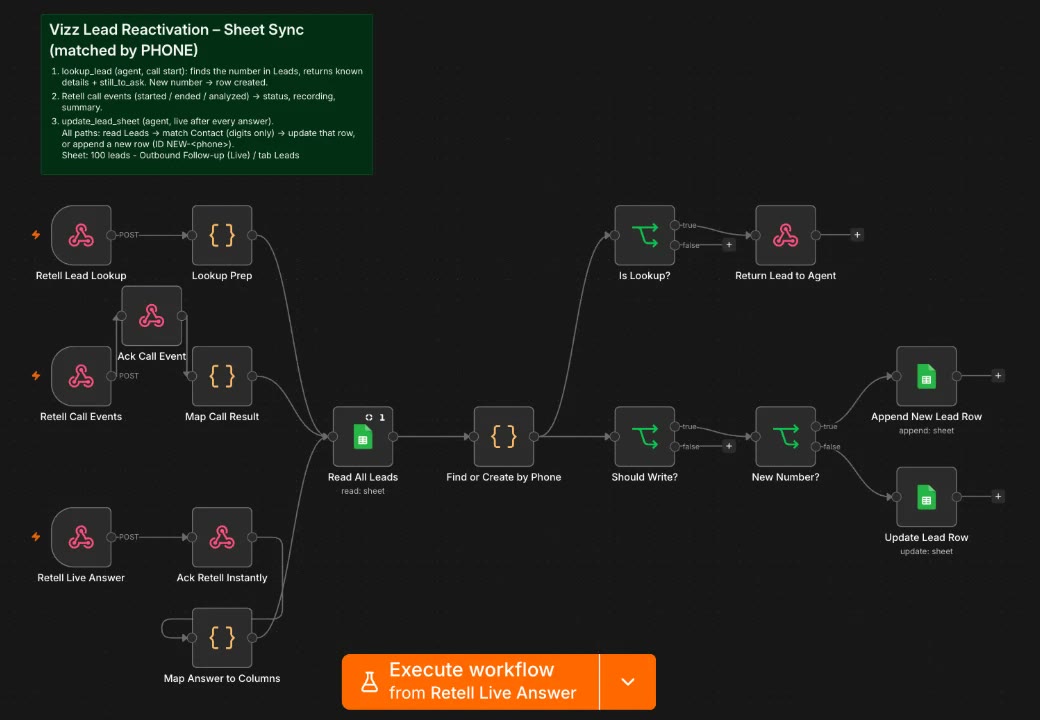
You don't need to write code. A first version can use a voice platform such as Retell or Vapi, with n8n connecting it to a Google Sheet or CRM. We walk through complete builds for free on YouTube, including a dental clinic assistant with Retell and n8n and a first call assistant with Vapi, Twilio and Make. Not sure which platform to use? Read our Retell AI vs Vapi comparison.
Your demo should do three things:
- Answer in a natural voice and ask the questions a good receptionist would ask.
- Write the answers into a sheet or CRM while the call is happening.
- Book the appointment or pass a qualified lead to a person.
The strongest version is an instant-callback demo. The prospect fills in a short form, and your AI calls their phone within seconds. Nothing you could say in a pitch works as well as that moment.
Step 3: Price it simply
Most agencies charge a one-time setup fee plus a monthly retainer. The example structure we teach is around $2,000 setup plus $700 a month. It's an example, not a rule, and you should set prices for your market.
Compare your price against what the client pays now, not against what the tools cost you. In the US, a receptionist earns a median of $38,010 a year in wages alone, and can only take one call at a time. Your running costs will be far lower. We broke down the real numbers in how much an AI voice agent costs.
Don't take percentages or "pay per booking" deals with your first client. They create arguments about what counts. Keep it simple until you have proof.
Step 4: Get your first client
Outreach is the part people avoid, and it's the only part that creates income.
- List 100 businesses in your niche, with the owner's name if you can find it.
- Send a short, specific message. Say what you noticed and offer the demo. "I called your clinic at 8pm and got voicemail. Want to hear what an AI receptionist would have said?" beats any generic pitch.
- Show the demo live on the call. Let them talk to it. Let them try to break it.
- Offer a small first step. A short paid pilot with a clear goal is easier to say yes to than a long contract.
If you're selling in the UAE, read the UAE telemarketing rules before making any outbound marketing calls, because the fines are serious.
Step 5: Deliver, then keep the client
Your first client is where you learn the job. Expect the first version to need work: real callers mumble, interrupt and ask odd questions.
- Listen to the recordings every week and fix what went wrong.
- Send a short monthly report: calls answered, leads qualified, bookings made.
- Give them a dashboard so they can see the results without asking you.
That reporting is the reason a client keeps paying each month. It also gives you the case study that wins the next client.
Mistakes that waste months
- Learning forever. You can't study your way to a client. Build one thing, then sell it.
- Serving everyone. "AI for all businesses" gives nobody a reason to choose you.
- Selling features. Owners don't care which model you use.
- Skipping compliance. Calling rules are real, and your client's name is on those calls.
- Expecting passive income. This is a service business, especially at the start. Some people will land a client quickly and some won't. Nobody can honestly promise you a number.
Is this still a good market?
Forecasts differ by publisher, but the direction is clear. Grand View Research puts the AI voice agents market at $2.54 billion in 2025, growing to about $35 billion by 2033. A forecast isn't your income, though. What matters is whether you can solve one real problem for one real business, and that part hasn't changed.
Frequently asked questions
Do I need to know how to code to start an AI agency?
No. Tools like Retell, Vapi, n8n and Make are visual or low-code. You do need to be comfortable following technical steps and testing your work carefully.
How much money do I need to start?
Very little. Retell and Vapi both offer free starting credits and charge by usage, so your first demo can cost a few dollars. A business domain and email are your other early costs.
How long does it take to get the first client?
It depends mostly on how much outreach you do. Our course sets a goal of a first client within 90 days, and that is a goal rather than a guarantee.
What should I charge my first client?
Start from the value of the problem you solve. Our example structure is around $2,000 setup plus $700 a month, but prices vary a lot by market and by what the system does.
What is the best niche for an AI agency?
The best niche combines high customer value, lots of inbound calls and staff who can't keep up. Clinics and real estate are common choices, but the one you can reach easily is usually the better pick.